Telegram Monitoring vs. Social Listening: Which Fits B2B Signal Work?
Compare Telegram monitoring and social listening by source scope, buying intent, verification, compliance, and workflow to choose a B2B signal stack.
- 01The choice depends on the business question
- 02What is being compared?
- 03Comparison table: six criteria that change the decision
Signals to watch
- Social listening is strongest when the question spans broad public brand and market conversation
- Telegram monitoring is strongest when selected communities contain operational detail and time-sensitive B2B events
- Neither approach proves buying intent without source context, verification and human judgment
- The right architecture may use broad listening for discovery and Telegram monitoring for evidence-rich qualification
Simply put, Telegram monitoring and social listening answer different questions. Social listening maps public brand and market conversation across broad networks; Telegram monitoring examines selected, authorized Telegram communities for traceable events such as supplier searches, vendor comparisons, deadlines and risk incidents. B2B teams should choose by source relevance and required action, not by feature count.
The choice depends on the business question
These approaches are often compared because both reduce the need to read every conversation manually. Their useful outputs are different.
- Choose social listening when the question is, “What is the market saying about our brand, category or campaign across public networks?”
- Choose Telegram monitoring when the question is, “Which discussions inside relevant Telegram communities may require verification or action now?”
- Use both when broad patterns matter, but the team also needs source-level evidence from communities where its market operates.
This is not an absolute ranking. Source coverage, permissions, business language and ownership of the next action determine the fit.
What is being compared?
Social listening is the practice of collecting and analyzing public conversation about brands, products, audiences and market topics across social and web sources. Vendor definitions differ; this article uses the broad category described in Sprout Social’s social-listening resources, not the feature set of one tool.
Telegram monitoring is the continuous review of Telegram groups, channels or other sources a team is authorized to access, using defined rules to identify important messages and events. A complete Telegram monitoring workflow preserves the source, context, time, reason for the alert and uncertainty.
TOP Prospect is a Telegram business-signal intelligence platform. It helps cross-border B2B teams organize selected community discussions into traceable acquisition, competitor, market and risk Signals. It is not a general-purpose listening layer for every social network.
Comparison table: six criteria that change the decision
| Evaluation criterion | Social listening | Telegram monitoring | Decision question |
|---|---|---|---|
| Primary source scope | Broad public social and web conversation, depending on vendor coverage | Selected Telegram groups, channels or connected sources within an authorized scope | Where does the target market actually discuss the problem? |
| Unit of analysis | Mentions, themes, sentiment, share of conversation and trends | Messages, threads, entities, events, intent evidence and cross-group duplicates | Does the team need a market pattern or a reviewable event? |
| Typical business output | Brand insight, audience insight, campaign feedback or category change | Candidate lead, vendor-switching event, market update or risk alert | Who owns the next action? |
| Context required | Often works at aggregate level, but important events still need source review | Usually requires speaker role, replies, source quality, time and operational detail | Can a reviewer verify why the result matters? |
| Speed requirement | Useful for ongoing trend and reputation analysis | Useful when a request, incident or deadline has a short action window | How quickly does the signal expire? |
| Main failure mode | Mistaking volume or sentiment for a concrete event | Mistaking a keyword match or casual question for buying intent | What evidence would disprove the alert? |
The matrix compares outcomes rather than feature counts because vendor coverage changes. Any procurement process should verify current source support, permissions, exports, retention and integrations directly with each provider.
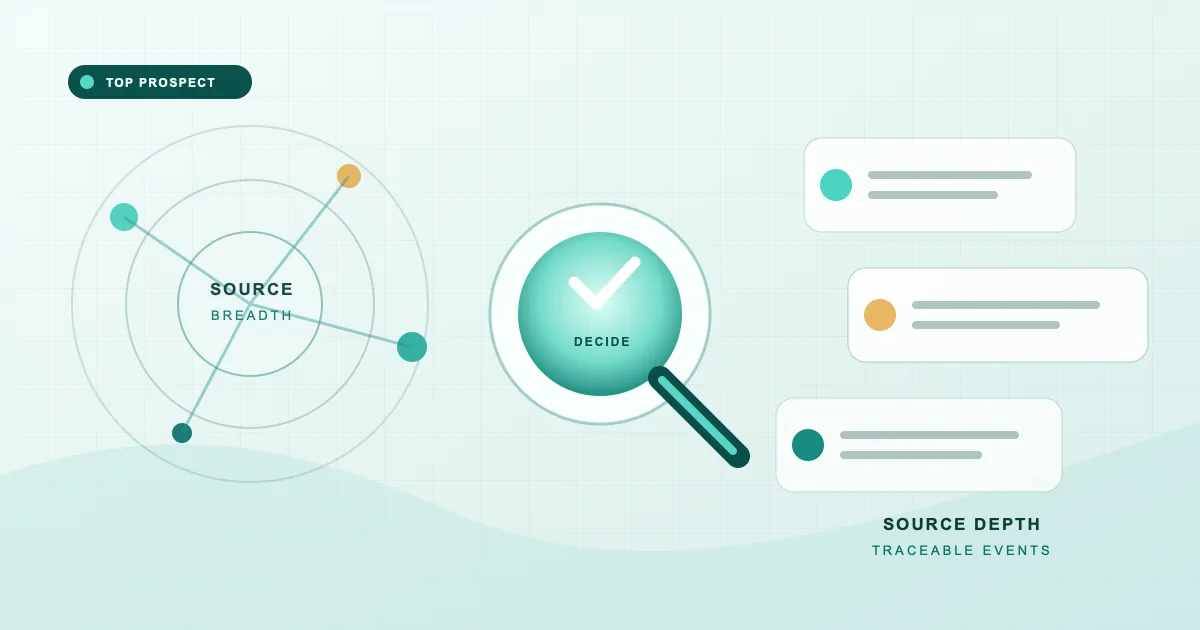
Source breadth and source depth create different evidence
Social listening prioritizes breadth. It can reveal that a brand, feature, competitor or category is receiving more discussion across covered sources. That is valuable for reputation, campaign and market questions, but a higher mention count does not by itself identify a buyer or explain an operational deadline.
Telegram monitoring prioritizes depth inside a selected source network. A useful discussion may contain the requested product, region, budget boundary, technical constraint, current provider and delivery date in one thread. The monitoring system still has to confirm that the speaker is relevant, the message is current and the need is not copied promotion.
The distinction is:
Social listening asks whether a conversation pattern matters. Telegram monitoring asks whether a specific discussion contains an event worth verifying.
Both can fail when the source network is poor. A broad dashboard cannot compensate for missing the communities where a niche market operates. A precise Telegram rule cannot represent a market that rarely uses Telegram.
Buying intent requires more than a mention
A mention such as “Has anyone tried Provider X?” can be research, support, promotion, criticism or procurement. Neither platform category should label it as a lead without more evidence.
For B2B qualification, review at least five fields:
- Actor: Is the speaker a potential buyer, vendor, recruiter, administrator or forwarder?
- Object: Which product, service or operational outcome is being discussed?
- Constraint: Are region, scale, integration, compliance or delivery requirements visible?
- Timing: Is there a deadline, renewal, incident or active evaluation window?
- Evidence: Can a reviewer return to the original source and see why the classification was made?
The five stages of B2B lead intent help separate awareness from active evaluation. The key rule is simple: AI classification can prioritize a message, but it cannot certify that a purchase will happen.
Verification and workflow matter more than alert volume
A usable alert is not a screenshot with a score. It should contain the original text, source, timestamp, relevant context, matched rule, reason for priority, uncertainty and suggested verification step.
That produces different downstream workflows:
Social listening
Theme or reputation change → analyst review → market or communications decision

Telegram monitoring
Candidate event → source verification → owner assignment → sales, product or risk action
Teams should measure the total cost of attention, not just the number of sources or alerts:
Review load = candidate alerts × average verification effort
Decision yield = verified events that enter a defined action ÷ reviewed alerts
These are operating definitions, not published benchmarks. Each team must calculate them from its own review history. They expose a common failure: a system can find more mentions while making the business slower.
When social listening is the better choice
Choose social listening first when most of these conditions are true:
- the brand or category is discussed across several public networks;
- the team needs reputation, campaign, audience or category-level analysis;
- aggregate patterns matter more than individual buyer identification;
- communications, research or marketing owns the result;
- the organization already has a workflow for investigating spikes and anomalies.
It is not ideal when a niche B2B market relies heavily on specialist Telegram communities that the selected vendor does not cover with sufficient context. Coverage must be verified; the label “social listening” does not establish access to a specific Telegram source.
When Telegram monitoring is the better choice
Choose Telegram monitoring first when most of these conditions are true:
- target buyers, suppliers or practitioners already use identifiable Telegram communities;
- discussions include projects, technical constraints, recommendations, vendor comparisons or deadlines;
- the team needs source-level context and a traceable reason for each alert;
- sales, BD, product intelligence or risk teams can review and own follow-up;
- the source list can be kept narrow, authorized and regularly audited.
It is not ideal when the audience barely uses Telegram, when the team wants a complete public-web reputation view, or when nobody can review ambiguous results. Use the Telegram source-quality audit before adding more groups.
When a combined stack is justified
A combined stack works when the tools answer separate stages of one decision:
- Social listening identifies a new theme, complaint cluster or competitor shift across covered public sources.
- An analyst defines what evidence would confirm or reject the pattern.
- Telegram monitoring checks relevant, authorized communities for operational details and independent discussion.
- Duplicates are merged, source diversity is assessed and uncertain cases remain uncertain.
- A verified event is routed to communications, product, sales or risk owners.
The combined stack is wasteful if both systems produce the same unowned alerts. Integration should begin with a shared event taxonomy, not a shared inbox.
Where TOP Prospect fits—and where it does not
TOP Prospect’s Telegram business-signal workflow is designed for teams that already know Telegram matters to their market. Users select communities they are authorized to access and define the acquisition, competitor, market or risk Signals they want to evaluate. The platform helps deduplicate, classify, prioritize and preserve evidence for human review.
Its boundaries are equally important:
- it does not claim to monitor every social network or every Telegram conversation;
- its base workflow does not read private chats;
- a Signal is a reviewable candidate, not proof of a buyer, incident or market trend;
- it does not automatically message group members;
- platform terms, permissions, purpose limitation and applicable law still govern use.
Telegram’s Privacy Policy distinguishes public chats from private communication, while its Terms of Service, API terms and content-licensing terms define additional constraints. Public visibility should never be translated into unlimited reuse rights.
A seven-question decision checklist
Before buying either category, answer these questions with evidence:
- Which exact business decision should the system improve?
- Where do the relevant people actually discuss that decision?
- Does the tool preserve the context required to verify a result?
- Which person or team owns each output?
- How will false positives, duplicates and stale alerts be recorded?
- What access, retention, deletion and AI-use rules apply?
- What result after 30 days would justify continuing the workflow?
If the answers point to broad market patterns, begin with social listening. If they point to event-rich Telegram communities and time-sensitive action, begin with Telegram monitoring. If both are necessary, connect them through a shared verification process rather than treating two dashboards as a strategy.
Frequently asked questions
Is Telegram monitoring the same as social listening?
No. Social listening usually analyzes public conversation across multiple social networks and web sources for brand, audience and market patterns. Telegram monitoring focuses on selected Telegram groups, channels or other sources a team is authorized to access, then identifies messages or events that match defined business questions.
Which approach is better for B2B lead generation?
Telegram monitoring is often the better fit when target buyers already discuss suppliers, technical constraints, projects and deadlines in relevant Telegram communities. Social listening is more useful when the team needs broader brand, category or audience coverage. Neither approach turns a mention into a qualified lead without verification.
Can a social listening tool monitor Telegram groups?
Coverage varies by vendor, source type, access method and account permissions. A feature label is not enough: ask which public channels, owned groups or deliberately connected groups are supported, whether message context is preserved, and how access, retention and deletion are handled.
Do B2B teams need both social listening and Telegram monitoring?
Some do. A combined workflow can use broad social listening to detect themes and reputation changes, then use Telegram monitoring to inspect relevant communities for operational context, buyer language and time-sensitive events. Teams should combine them only when each source changes a real decision.
How should a team evaluate compliance?
Document the access method, source permissions, purpose, retention, deletion, user roles and applicable law. Review Telegram's current Terms of Service, API terms, content-licensing terms and privacy policy. Public visibility should not be treated as unlimited permission to collect or reuse content.
Is TOP Prospect a general social listening platform?
No. TOP Prospect is a Telegram business-signal intelligence platform for selected communities a team deliberately connects and is authorized to access. It organizes traceable acquisition, competitor, market and risk Signals; it is not designed to measure every public network or automatically contact group members.